
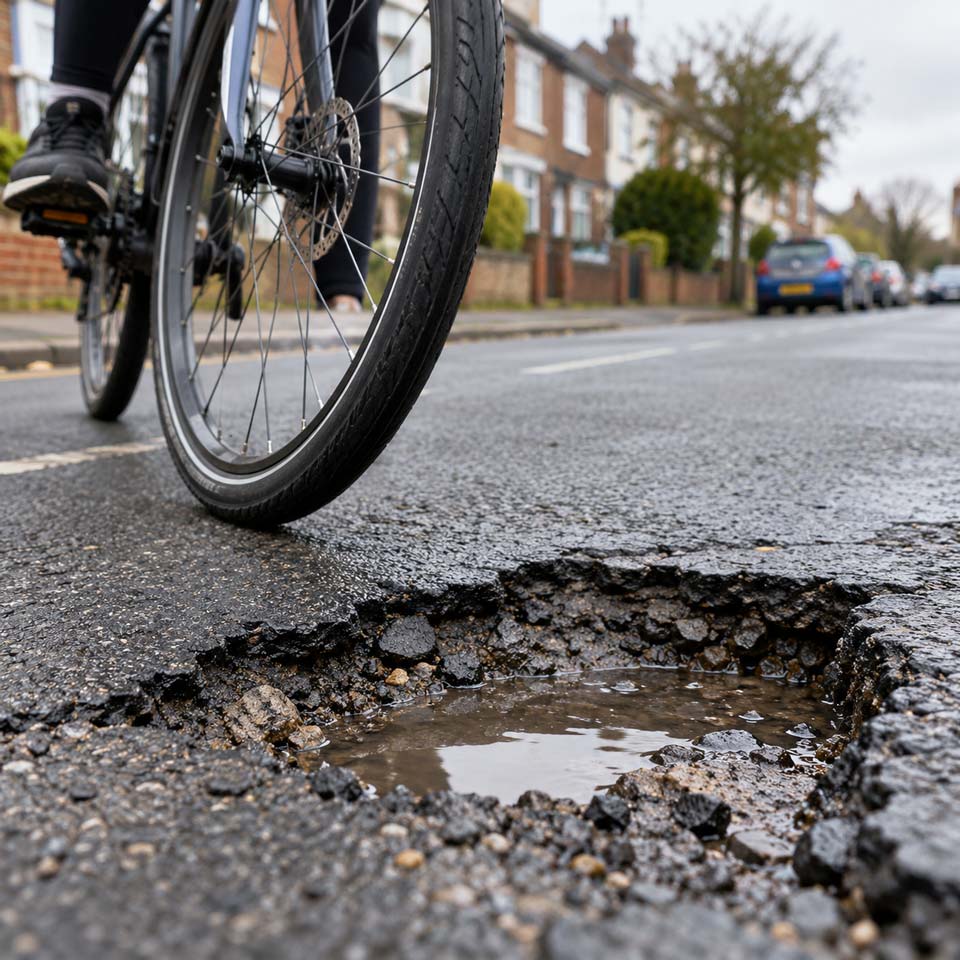
A pothole might seem like a relatively minor road defect, but it can cause serious injuries. A cyclist might be thrown from their bicycle after hitting a deep pothole, a pedestrian could trip on a damaged pavement, or a driver could lose control of their vehicle after striking a defective section of road.
If you have been injured in an accident caused by a pothole, you may be entitled to claim compensation. However, the fact that a pothole caused your accident does not automatically mean that your local council, the highway authority or a private landowner is legally responsible.
Whether you can make a successful pothole injury claim depends on several factors, including where the accident happened, the condition of the road, whether the defect had previously been reported, how the responsible organisation maintained the area and the circumstances of your accident.
In this guide, we explain how pothole injury claims work, who might be responsible and what evidence you need to support your case.
At ASL Solicitors, we specialise in personal injury claims, helping people in Rochdale and across Greater Manchester understand their legal rights following an accident. If you have suffered an injury because of a pothole, we can assess your circumstances and give you a realistic opinion on whether a compensation claim can be pursued.
Can You Claim Compensation for an Injury Caused by a Pothole?
Yes, it is possible to claim compensation if you have suffered an injury caused by a pothole. However, you generally need to demonstrate that another person or organisation was legally responsible for maintaining the area and failed to take reasonable steps to keep it safe.
For example, if a council had received several reports about a dangerous pothole but failed to inspect or repair it within a reasonable period, an injured road user might have grounds to bring a claim.
Alternatively, if a pothole developed only hours before an accident and the local authority had been operating an appropriate inspection and maintenance system, establishing liability could be considerably more difficult.
Importantly, you do not necessarily need to prove that the pothole had previously been reported. A claim might still succeed if the defect should reasonably have been discovered through inspections or maintenance.
The central questions are whether the pothole presented an actionable danger, whether the responsible party breached its legal duties and whether that failure caused your injury.
How Many Accidents Are Caused by Potholes Each Year in the UK?
Pothole-related accidents are a significant road safety concern, but there is an important distinction between accidents caused specifically by potholes and accidents involving defective road surfaces more generally.
The Department for Transport does not publish a definitive annual UK-wide figure identifying potholes as the sole cause of accidents. Instead, police-recorded road collision statistics include a broader category covering poor or defective road surfaces and deposits on roads.
In a parliamentary response published in January 2026, the Department for Transport provided the following figures for reported personal injury road collisions in Great Britain where the road safety factor “Poor or defective road surface or deposits on road” was recorded:
- 2022: 1,092 reported personal injury collisions.
- 2023: 1,248 reported personal injury collisions.
- 2024: 1,378 reported personal injury collisions.
These figures were taken from police-recorded STATS19 data and include accidents involving a range of road surface problems, not just potholes. The assigned factors reflect circumstances considered relevant by reporting police officers and do not establish that the road surface was the sole cause of each accident. Changes to the recording system also affect comparisons between years. [1]
Furthermore, these figures do not capture every pothole-related injury. Some accidents are never reported to the police, while incidents involving pedestrians falling without a vehicle being involved and accidents in private car parks are generally outside the scope of these road collision statistics.
Consequently, the true number of people injured in pothole-related accidents is difficult to establish.
How Many Potholes Are Reported Each Year?
There is no single, comprehensive government dataset showing every pothole reported across the UK. In March 2026, the Department for Transport confirmed that it does not hold national data on the number of pothole reports submitted to local authorities. [2]
However, research based on Freedom of Information requests provides an indication of the scale of the problem.
Research published by Confused.com in 2026 found that more than 3.4 million pothole reports had been recorded by responding UK councils between 2022 and 2025. More than 600,000 reports related to 2025 alone.
The research involved responses from 183 out of 207 councils contacted, with 2025 information supplied to the extent available when the requests were made. These figures therefore represent the councils included in the research, rather than a complete national census. [3]
Separately, the Asphalt Industry Alliance’s ALARM 2026 survey estimated that 1,903,498 potholes were filled across England and Wales during 2025/26, equivalent to more than 5,200 repairs every day.
This is an estimate derived from local authority maintenance survey responses. It measures potholes filled rather than potholes reported, so the two sets of figures should not be treated as interchangeable. [4]
How Much Compensation Is Paid for Pothole Accidents?
Statistics on compensation payments provide another indication of the financial consequences of poorly maintained roads.
The Asphalt Industry Alliance’s ALARM 2026 report estimated that local authorities in England and Wales paid £15.9 million in road user compensation claims during 2025/26, compared with £19.7 million reported in the previous survey.
The report also found that approximately 99% of the claims received related specifically to potholes affecting roads, footways or cycleways. These figures include different types of road user claims and are not a separate measure of compensation paid exclusively for personal injuries. [4]
Meanwhile, Confused.com’s Freedom of Information research identified more than £11 million in compensation paid by participating UK councils for pothole-related vehicle damage claims between 2022 and 2025, including approximately £1.1 million during 2025. Its research reported that 19% of claims were successful in 2025. [3]
The surveys cover different authorities, periods and claim categories, so their payout figures should not be added together or directly compared.
It is also important not to confuse compensation for a damaged tyre or wheel with compensation for a personal injury. An injury claim may involve medical evidence, loss of earnings and other losses that do not arise in a vehicle damage claim.
There is no reliable national success rate that can tell an individual injured person how likely their pothole compensation claim is to succeed.
Who Is Responsible for a Pothole?
Determining who is responsible for the location of the pothole is one of the first steps in assessing a compensation claim.
The responsible party will depend on whether the accident occurred on a publicly maintained highway, a motorway, a privately maintained road, a car park or another type of premises.
Potholes on Public Roads and Highways
In England and Wales, Section 41 of the Highways Act 1980 places a statutory duty on highway authorities to maintain highways that are maintainable at public expense.
This includes many public roads, pavements and other publicly maintained highways.
For most local roads, the relevant highway authority will be the local council responsible for highway maintenance. In Greater Manchester, this might be Rochdale Borough Council, Manchester City Council, Oldham Council or another metropolitan borough council, depending on the location.
However, the duty is not an absolute guarantee that every public road will always be free of potholes. The law recognises that defects can develop between inspections and that authorities must be assessed against the standard of reasonable maintenance.
Section 58 of the Highways Act 1980 also provides highway authorities with a defence where they can establish that they took the care reasonably required in the circumstances to prevent the highway from being dangerous. [5] [6]
Potholes on Motorways and Major A-Roads
In England, National Highways manages and maintains the strategic road network, which includes motorways and certain major A-roads.
For example, if you were injured after your vehicle struck a pothole on a section of the M62 managed by National Highways, the relevant claim would ordinarily need to be considered against the responsible strategic highway authority rather than your local council.
Not every A-road is managed by National Highways. Some remain the responsibility of local highway authorities.
In certain parts of London, Transport for London is also the relevant highway authority.
It is therefore important to establish who was legally responsible for maintaining the specific stretch of road where your accident occurred.
Potholes in Supermarket and Shopping Centre Car Parks
If you were injured by a pothole in a supermarket car park, retail park, shopping centre or another privately managed car park, different legal duties may apply.
Under the Occupiers’ Liability Act 1957, an occupier generally owes lawful visitors a duty to take reasonable care to ensure that they are reasonably safe when using the premises for the purposes for which they are permitted to be there.
An occupier is not necessarily the owner of the land. It may be the supermarket, shopping centre operator, management company or another organisation with sufficient control over the premises.
For example, imagine you were walking through a supermarket car park when your foot became trapped in a deep, poorly maintained pothole. You fell and suffered a fractured wrist.
If the pothole had been present for a considerable period, was located along a pedestrian route and should reasonably have been identified and addressed, the organisation responsible for maintaining the car park could potentially be liable.
However, liability would still depend on the circumstances, including the hazard’s visibility, inspection arrangements and whether reasonable safety precautions had been taken. [7]
Potholes on Private Roads and Residential Developments
Some housing developments, private estates and access roads have not been adopted by the local highway authority.
In these circumstances, responsibility might rest with a private landowner, residents’ management company, developer or another party responsible for maintaining the road.
It is important to distinguish between a road being privately owned and being legally maintained at public expense. Ownership alone does not necessarily determine which legal duty applies.
If a private road has been adopted as a publicly maintainable highway, the relevant highway authority may still be responsible for its maintenance.
For an unadopted road, it may be necessary to examine ownership records, management agreements and who exercises control over the area. Depending on the circumstances, a claim could involve the Occupiers’ Liability Act 1957 or the law of negligence.
The Occupiers’ Liability Act 1984 can also be relevant where an injured person was not a lawful visitor, although duties to non-visitors arise only where the statutory conditions are satisfied. [8]
Potholes Caused by Utility Companies or Roadworks
Sometimes a dangerous section of road develops after excavation work carried out by a utility company or contractor.
The New Roads and Street Works Act 1991 includes requirements concerning reinstatement following street works. In particular, Section 70 places a duty on undertakers carrying out street works to reinstate the street in accordance with the applicable requirements. [9]
If an injury results from defective reinstatement or unsafe works, responsibility may involve the utility company, contractor, highway authority or more than one party.
Determining liability can require an investigation into the work that was carried out, who was responsible and whether the relevant duties were breached.
Can You Claim If the Pothole Had Already Been Reported?
A previous report can be valuable evidence in a pothole injury claim because it may help establish that the responsible authority knew about the defect before the accident.
However, a prior report is not sufficient by itself to prove liability.
Scenario 1: The Council Received Several Reports but Did Not Repair the Pothole
Imagine that a large pothole develops on a road frequently used by cyclists. Local residents report it to the council several times over a period of weeks, explaining that it presents a danger.
No effective action is taken and a cyclist subsequently strikes the pothole, falls from their bicycle and suffers a broken collarbone.
In this situation, the previous complaints could provide important evidence that the council had been made aware of a potentially dangerous defect.
Investigations would then focus on when the reports were received, how the defect was assessed, the council’s inspection and repair policies, and whether its response was reasonable.
If the council failed to take reasonable steps in the circumstances, there could be grounds for a compensation claim.
Scenario 2: The Pothole Was Reported Shortly Before the Accident
Now consider a pothole that was first reported to the highway authority on a Monday morning. A cyclist suffers an injury after striking it later that afternoon.
The fact that a report was made does not automatically mean the council should have repaired the pothole within those few hours.
The assessment would depend on the urgency of the danger, the highway’s characteristics, the authority’s response procedures and the time reasonably required to investigate and address the defect.
A particularly serious hazard may justify a faster response than a minor defect on a lightly used road.
However, if the council had followed a reasonable inspection and response system, it might be able to defend the claim.
Can You Claim If the Pothole Had Never Been Reported?
Yes. A pothole does not necessarily have to have been reported previously for an injury claim to succeed.
Highway authorities are expected to operate reasonable systems for inspecting and maintaining roads under their responsibility. They cannot necessarily avoid liability simply by arguing that no member of the public had complained.
For example, suppose a dangerous pothole had been developing for several months on a busy road. An injured cyclist might argue that appropriate inspections should have identified it before their accident.
Evidence that the authority failed to conduct inspections in accordance with a reasonable policy, or overlooked a defect that should have been identified, could support a claim.
On the other hand, if a pothole appeared suddenly between appropriately timed inspections following severe weather, and the authority had no reasonable opportunity to discover or address it, its defence may be stronger.
This is where Section 58 of the Highways Act 1980 becomes particularly important. In October 2026, the Government reiterated that highway authorities may defend claims where they demonstrate that they took the care reasonably required, with disputed liability ultimately determined by the courts. [10]
At ASL Solicitors, we understand that injured people will often have no idea whether a pothole was previously reported. We can assess the available evidence and consider whether further investigation into inspection and maintenance records would be appropriate.
Does the Size or Depth of a Pothole Affect Your Claim?
Yes. The size, depth and position of a pothole can significantly affect whether it is considered dangerous and whether a compensation claim is likely to succeed.
However, there is no single national legal rule stating that a pothole must be a particular depth before compensation can be claimed.
In June 2026, the Government confirmed that local highway authorities determine their own pothole intervention criteria, based on factors such as size, depth, traffic conditions, location and risk. There is no nationally prescribed minimum pothole depth. [11]
Is a Pothole 40mm Deep Enough for a Claim?
A depth of 40mm, or 4cm, is frequently mentioned in relation to pothole repairs.
The Asphalt Industry Alliance’s ALARM 2026 report found that 73% of responding local authorities used a guideline depth of 40mm when defining potholes. [4]
Nevertheless, this is a common maintenance guideline rather than a universal legal threshold.
A pothole deeper than 40mm does not automatically establish negligence. Equally, a shallower defect may still present an unreasonable danger in particular circumstances.
For example, a depression of 25mm on a footway or cycle route might create a meaningful hazard depending on its shape, position and the people expected to use it.
A court would consider the overall circumstances rather than simply comparing the defect against a single measurement.
What Other Factors Matter?
Alongside its depth, the width, length, shape and position of a pothole can influence the risk it presents.
A narrow pothole that catches a bicycle wheel may present a different risk from the same defect encountered by a car. Similarly, a pothole on a pedestrian crossing, a busy cycle route or an area with poor visibility may require particular attention.
The amount and type of traffic, previous complaints, surrounding road conditions and whether warning measures were appropriate can also be relevant.
Photographs showing the pothole’s dimensions and position can therefore be extremely useful, provided they can be obtained safely.
Pothole Injury Claims for Pedestrians
Pedestrians can suffer injuries after tripping over potholes or other defects in pavements, pedestrian crossings, public footpaths and car parks.
Common injuries include fractured wrists, broken ankles, knee injuries, cuts, soft tissue injuries and head injuries.
Consider someone walking along a pavement in Rochdale who trips after their foot catches in a broken section of surface beside a drain cover.
If the pavement is publicly maintained and the defect created a danger that the responsible highway authority should reasonably have addressed, a personal injury claim may be possible.
Similar circumstances can arise in private car parks, where the occupier’s legal duties may apply instead.
The strength of a pedestrian claim can depend on the defect’s dimensions, whether it was readily visible, the surrounding conditions and the injured person’s own actions.
An accident does not automatically become the pedestrian’s responsibility because they could theoretically have noticed the defect. Equally, the presence of an uneven surface does not automatically mean that the organisation responsible was negligent.
Pothole Injury Claims for Cyclists
Cyclists can be particularly vulnerable to potholes because relatively small road defects can destabilise a bicycle or trap its front wheel.
A cyclist hitting a pothole at speed may be thrown over the handlebars, resulting in injuries such as fractured collarbones, broken wrists, shoulder injuries, facial injuries or head trauma.
A pothole injury claim involving a cyclist may be stronger where there is clear evidence that the defect presented a foreseeable danger to cyclists and that the responsible authority failed to maintain the road to a reasonable standard.
For example, a deep pothole positioned close to the kerb on a frequently used cycling route may create a hazard that differs substantially from an equivalent defect elsewhere on the carriageway.
Investigations may also consider whether the cyclist was travelling at an appropriate speed, whether the defect was visible and whether it could reasonably have been avoided.
Importantly, cyclists are not automatically responsible for an accident because they failed to avoid a pothole. The surrounding traffic, lighting, weather and road layout must all be considered.
If you have been injured while cycling, we can help assess whether the accident was caused by a failure to maintain the road or whether another party may have been responsible.
Pothole Injury Claims for Drivers and Motorcyclists
Drivers may suffer injuries after hitting a pothole, particularly where the impact causes a loss of control, damage to steering or suspension, or a collision with another vehicle or roadside object.
For example, a driver might strike a substantial pothole, lose control of their vehicle and collide with a roadside barrier, suffering a neck or back injury.
Motorcyclists can be especially exposed to serious injuries because a pothole may destabilise the motorcycle and cause the rider to fall onto the road.
In these cases, the assessment will usually consider the road defect, the vehicle’s condition, travelling speed, visibility, driver or rider behaviour and whether the highway authority failed to meet its maintenance obligations.
If another vehicle was involved, there may also be questions about whether another driver was partly or wholly responsible for the collision.
What If Only Your Vehicle Was Damaged?
It is possible to pursue compensation for pothole-related vehicle damage without suffering a personal injury, but this is a different type of claim.
Vehicle damage claims can involve repairs to tyres, wheels, suspension or steering components.
GOV.UK provides guidance on identifying the organisation responsible for the road when making a vehicle damage claim. [12]
If you have also suffered an injury, there may be additional losses to consider, and it is important that the personal injury element is properly investigated.
What Factors Affect Your Chances of Winning a Pothole Injury Claim?
Every accident is different, and the existence of a pothole does not automatically establish a valid compensation claim.
Some of the most important considerations include:
- Responsibility for maintenance: Whether the proposed defendant had a legal duty concerning the road, pavement or premises.
- Nature of the defect: Whether the pothole was sufficiently dangerous in its particular location and circumstances.
- Previous knowledge: Whether the responsible party knew, or should reasonably have known, about the defect.
- Inspection and repair arrangements: Whether appropriate inspections were undertaken and reported dangers were addressed reasonably.
- Evidence of causation: Whether the pothole actually caused the accident and the injuries being claimed.
- Contributory negligence: Whether the injured person’s actions contributed to the accident.
- Quality of evidence: Whether photographs, witness statements, medical evidence and records support the claim.
A well-documented accident involving a dangerous pothole that had been left unrepaired despite repeated warnings may be easier to establish than an accident involving a small, newly formed defect that could not reasonably have been discovered earlier.
However, there are no guarantees. Liability must be assessed on the facts and evidence of each case.
What If You Were Partly Responsible for the Accident?
Being partly responsible for an accident does not necessarily prevent you from claiming compensation.
Under the Law Reform (Contributory Negligence) Act 1945, damages can be reduced where an injured person’s own fault contributed to the harm they suffered.
For example, suppose a driver suffered injuries after hitting a dangerous pothole, but the evidence also demonstrated that they were travelling at an excessive speed for the road conditions.
A court might conclude that both the dangerous road condition and the driver’s conduct contributed to the accident.
If damages were assessed at £20,000 and the driver was found to be 25% responsible, the recoverable damages would be reduced to £15,000.
This is an illustrative calculation rather than a prediction of how responsibility would be apportioned in a particular case. The reduction must be assessed on what is just and equitable in the circumstances. [13]
The same principle can apply to pedestrians, cyclists and motorcyclists.
For instance, visibility, distraction, road position or speed might become relevant, but an allegation of contributory negligence must still be supported by the evidence.
What Evidence Do You Need for a Pothole Injury Claim?
Evidence is extremely important when pursuing compensation following a pothole accident.
One of the main difficulties with these claims is that potholes can change quickly. A defect might become larger after heavy rain or be repaired shortly after an accident.
Gathering reliable evidence as soon as reasonably possible can help establish what the road looked like at the time of your injury.
Evidence to Collect After Your Accident
- Photographs of the pothole: If it is safe, obtain photographs showing its depth, width, position and surrounding area. Never enter live traffic or stop somewhere dangerous to take measurements.
- Accident details: Keep a written record of the date, time, road name, nearby landmarks and exactly how the accident happened.
- Medical records: Seek appropriate medical attention and retain records of your diagnosis, treatment and recovery.
- Witness information: Obtain contact details for anyone who saw the accident or can confirm the condition of the road.
- CCTV or video footage: Dashcam, helmet camera, business CCTV or other recordings may help establish what happened. Request preservation promptly because footage can be overwritten.
- Financial records: Keep receipts, repair invoices, travel costs and evidence of lost earnings or other accident-related expenses.
- Previous reports: Any records showing that the pothole had previously been reported may help establish the responsible party’s knowledge.
You should also retain any correspondence with the council, insurer, landowner or other organisation responsible for the area.
Can You Obtain the Council’s Inspection Records?
Yes, relevant inspection, maintenance and complaint records may be obtainable as part of investigating a claim.
Depending on the circumstances, a solicitor may seek details of previous inspections, defect reports, repairs, maintenance policies and other incidents involving the same location.
Some information may be requested under the Freedom of Information Act 2000, while relevant documents may also be obtained through the disclosure procedures applicable to personal injury claims.
The availability and relevance of these records will depend on the individual case.
At ASL Solicitors, we can review the evidence you already have and consider what additional information may be required to assess liability.
What Compensation Can You Claim Following a Pothole Injury?
If your claim is successful, compensation may cover both the injury itself and certain financial losses resulting from the accident.
Compensation for Pain, Suffering and Loss of Amenity
This is commonly referred to as general damages.
The amount depends on matters such as the type of injury, its severity, the recovery period, any permanent symptoms and the impact on everyday life.
For example, a fractured wrist requiring several weeks of recovery would generally be assessed differently from a serious spinal injury causing long-term disability.
Medical evidence is particularly important in determining the nature and extent of an injury.
Compensation for Financial Losses
You may also be able to recover reasonable financial losses caused by the accident. These are often described as special damages.
Examples include loss of earnings, medical expenses, rehabilitation costs, travel expenses and necessary care or assistance.
In suitable cases, future losses may also be considered, particularly where an injury causes long-term restrictions on employment or requires continuing treatment.
Damage to personal belongings, including a bicycle, clothing or other property, may also be recoverable where legally justified.
The value of an individual claim should be supported by medical evidence and evidence of the losses suffered. There is no fixed compensation amount simply because an accident involved a pothole.
How Long Do You Have to Make a Pothole Injury Claim?
In England and Wales, the general limitation period for a personal injury claim is three years from the date of the accident or, in certain circumstances, the injured person’s later date of knowledge.
This is governed principally by Section 11 of the Limitation Act 1980.
There are important exceptions. For example, where a child is injured, the ordinary three-year period generally does not begin until their 18th birthday, meaning they will normally have until their 21st birthday to issue proceedings. A parent or other appropriate adult may be able to bring a claim on the child’s behalf earlier.
Different rules may apply where the injured person lacks the relevant mental capacity, and the court has a limited discretion to disapply certain time limits. [14]
It is important to understand that the limitation period generally concerns starting court proceedings, not simply contacting the council or submitting a compensation form.
Waiting until the end of the limitation period can make a claim more difficult, especially when inspection records, witnesses or CCTV evidence need to be obtained.
We recommend obtaining legal advice as soon as reasonably possible following an accident.
What Should You Do After Being Injured by a Pothole?
Your health should always be the first priority. If you have been involved in a serious accident, seek emergency assistance where necessary. Even injuries that initially appear relatively minor may require medical assessment.
Once you are safe, try to record the circumstances of the accident. The exact location, date, time and nature of the road defect can become important evidence later.
If photographs can be obtained safely, they may help demonstrate the pothole’s condition before it is repaired.
You should also report the pothole to the relevant council or road authority. This can help protect other road users and create a record of the defect.
The Government provides an online pothole reporting service to help identify the relevant authority. [17]
Importantly, do not put yourself at risk by attempting to measure or photograph a pothole on a busy carriageway or motorway.
Finally, consider seeking advice from a personal injury solicitor, particularly if the injury has required medical treatment, caused you to miss work or affected your daily activities.
How Does the Pothole Compensation Claims Process Work?
Most claims begin with an assessment of the circumstances rather than immediate court proceedings.
Step 1: Initial Assessment
We start by considering where the accident happened, the injuries sustained, who may have been responsible and what evidence is available.
We also consider potential obstacles, such as whether the defect was sufficiently dangerous or whether a highway authority may have a reasonable maintenance defence.
If we believe the prospects of pursuing a claim are limited, we will explain our assessment rather than suggest that compensation is guaranteed.
Step 2: Investigating Liability
Where appropriate, the next stage involves obtaining and reviewing evidence relevant to liability.
This may include photographs, accident reports, witness evidence, maintenance records and previous complaints.
The purpose is to establish whether the responsible party breached a legal duty and whether that breach caused the accident.
Step 3: Medical Evidence and Financial Losses
If a claim is pursued, medical evidence may be needed to establish the extent of the injuries, recovery prospects and ongoing symptoms.
Financial losses are also documented so that an appropriate valuation can be considered.
Step 4: Negotiations and Possible Settlement
Many personal injury disputes can be resolved without a final court hearing.
The applicable Civil Procedure Rules and pre-action protocols encourage appropriate investigation, exchange of information and consideration of settlement before proceedings are pursued.
The particular pre-action procedure depends on the nature and value of the claim. [18]
If liability is admitted and the parties agree on compensation, the claim may be settled without a trial.
Where liability or the amount of compensation remains disputed, court proceedings may be required.
Can You Claim Against the Council If It Rejects Responsibility?
Yes. A council rejecting an initial compensation claim does not necessarily mean that the claim cannot be pursued further.
For example, the council might rely on Section 58 of the Highways Act 1980 and argue that it operated an appropriate inspection and maintenance system.
However, that defence must be considered against the actual evidence.
Questions may arise about whether inspections took place as recorded, whether the relevant maintenance policy was reasonable, whether previous defects had been identified and whether reported dangers were properly addressed.
If the evidence does not support the council’s position, there may be grounds to challenge its rejection.
Equally, where the council can establish an appropriate and properly implemented maintenance system, and the accident resulted from a defect it could not reasonably have discovered or repaired, its defence may succeed.
This is why we assess each case individually rather than treating every pothole accident as a valid compensation claim.
Speak to ASL Solicitors About Your Pothole Injury Claim
If you have suffered an injury because of a pothole, it can be difficult to know whether you have grounds for compensation, particularly if the council or another responsible organisation disputes liability.
At ASL Solicitors, we specialise in personal injury claims and help injured people understand their options.
Based in Rochdale, we provide personal injury services to clients throughout Rochdale and across Greater Manchester.
We can consider the circumstances surrounding your accident, the available evidence, the applicable legal duties and any potential defences before providing a realistic assessment of whether a claim can be pursued.
Whether you were injured while walking, cycling, driving or riding a motorcycle, we understand that an accident can have consequences beyond the initial injury, particularly where recovery takes time or affects your ability to work.
To discuss your circumstances, visit our personal injury solicitors page or contact us to explain what happened.
Frequently Asked Questions About Pothole Injury Claims
Can I claim compensation if I tripped over a pothole?
Yes, potentially. If you suffered an injury after tripping over a pothole on a pavement, public footpath or privately managed area, you may have grounds for compensation if the responsible party breached its legal duty and that failure caused your injury.
Can I claim if the pothole had not been reported?
Yes. A previous report is not always necessary. A claim may still be possible where a dangerous defect should reasonably have been identified through appropriate inspections or maintenance. However, the responsible authority may have a defence if it took reasonable care.
Does a pothole need to be 40mm deep to claim compensation?
No. There is no universal legal requirement for a pothole to be at least 40mm deep before a compensation claim can be pursued. The defect’s size, position, surrounding conditions and danger to road users are all relevant.
Can I claim for a pothole injury in a supermarket car park?
Yes, potentially. If you were injured by a dangerous pothole in a supermarket car park, the occupier or another responsible party may be liable under the Occupiers’ Liability Act 1957 or other applicable law. Liability depends on control of the premises and the circumstances of the accident.
Can cyclists claim against a council for pothole injuries?
Yes. Cyclists may be able to claim compensation where a dangerous pothole on a publicly maintained highway caused an injury and the responsible highway authority failed to meet its statutory maintenance obligations.
Can I claim if I lost control of my car after hitting a pothole?
Possibly. If the pothole caused you to lose control of your vehicle and suffer injuries, a claim may be available where the responsible authority breached a legal duty. Your speed, the road conditions and other circumstances will also be considered.
Can I still claim if the pothole has been repaired?
Yes. Repairing a pothole after an accident does not automatically prevent a compensation claim. Earlier photographs, witness evidence, accident records and maintenance information may help establish its previous condition. However, the repair itself does not necessarily prove that the responsible party was negligent.
How much compensation can I receive for a pothole injury?
Compensation depends on the severity of your injury, its impact on your life and any recoverable financial losses. There is no fixed payment for a pothole accident, and an individual assessment is needed to establish a reasonable valuation.
How long do I have to claim for a pothole injury?
In England and Wales, the usual limitation period for personal injury proceedings is three years from the accident or, where applicable, a later date of knowledge. Different rules can apply to children and people who lack the relevant mental capacity.
Can I claim if the council denies responsibility?
Yes. An initial rejection does not necessarily prevent further action. The council’s reasons and supporting evidence need to be examined, particularly where it relies on the Section 58 maintenance defence.
Do pothole injury claims always go to court?
No. Many personal injury claims are resolved through negotiation without a final court hearing. However, court proceedings may be necessary where liability or the amount of compensation cannot be agreed.
Who should I contact about a pothole injury in Rochdale?
If you have suffered an injury because of a pothole in Rochdale or elsewhere in Greater Manchester, you can contact ASL Solicitors. We can review the circumstances and provide a realistic assessment of whether you may have grounds for a personal injury claim.
References
1) UK Parliament, Department for Transport – Roads: Accidents, Written Answer, 12 January 2026.
https://questions-statements.parliament.uk/written-questions/detail/2026-01-02/102503
2) UK Parliament, Department for Transport – Roads: Repairs and Maintenance, Pothole Reporting Data, 16 March 2026.
https://questions-statements.parliament.uk/written-questions/detail/2026-03-10/119741
3) Confused.com – Britain’s Pothole Crisis: Over 3 Million Reported in the Last Four Years, 2026.
https://www.confused.com/press/releases/2026/britains-pothole-crisis-over-three-million-reported-in-the-last-four-years
4) Asphalt Industry Alliance – Annual Local Authority Road Maintenance Survey (ALARM) 2026, pages 20, 23 and 24.
https://www.asphaltuk.org/wp-content/uploads/ALARM-Survey-2026.pdf
5) UK Legislation – Highways Act 1980, Section 41: Duty to Maintain Highways Maintainable at Public Expense.
https://www.legislation.gov.uk/ukpga/1980/66/section/41
6) UK Legislation – Highways Act 1980, Section 58: Special Defence in Actions Against Highway Authorities.
https://www.legislation.gov.uk/ukpga/1980/66/section/58
7) UK Legislation – Occupiers’ Liability Act 1957, Section 2: Extent of Occupier’s Ordinary Duty.
https://www.legislation.gov.uk/ukpga/Eliz2/5-6/31/section/2
8) UK Legislation – Occupiers’ Liability Act 1984, Section 1: Duty to Persons Other Than Visitors.
https://www.legislation.gov.uk/ukpga/1984/3/section/1
9) UK Legislation – New Roads and Street Works Act 1991, Section 70: Duty of Undertaker to Reinstate.
https://www.legislation.gov.uk/ukpga/1991/22/section/70
10) UK Parliament, Department for Transport – Highways Act Section 58 and Compensation Claims, Written Answer, 16 October 2026.
https://questions-statements.parliament.uk/written-questions/detail/2026-10-09/33044
11) UK Parliament, Department for Transport – National Definition of a Pothole, Written Answer, 8 June 2026.
https://questions-statements.parliament.uk/written-questions/detail/2026-05-21/hl385
12) GOV.UK – Claim for Damage to Your Vehicle.
https://www.gov.uk/claim-for-damage-to-your-vehicle
13) UK Legislation – Law Reform (Contributory Negligence) Act 1945, Section 1.
https://www.legislation.gov.uk/ukpga/Geo6/8-9/28/section/1
14) UK Legislation – Limitation Act 1980, Section 11: Special Time Limit for Personal Injury Actions.
https://www.legislation.gov.uk/ukpga/1980/58/section/11
15) UK Legislation – Roads (Scotland) Act 1984, Section 1: Powers and Duties of Local Roads Authorities.
https://www.legislation.gov.uk/ukpga/1984/54/section/1
16) UK Legislation – Roads (Northern Ireland) Order 1993, Article 8: Duty to Maintain Roads.
https://www.legislation.gov.uk/nisi/1993/3160/article/8
17) GOV.UK – Report a Pothole.
https://www.gov.uk/report-pothole
18) Civil Procedure Rules, Ministry of Justice – Pre-Action Protocol for Personal Injury Claims.
https://www.justice.gov.uk/courts/procedure-rules/civil/protocol/prot_pic
Legal information correct as of October 2026. This article provides general information about pothole injury claims and is not a substitute for legal advice tailored to individual circumstances.